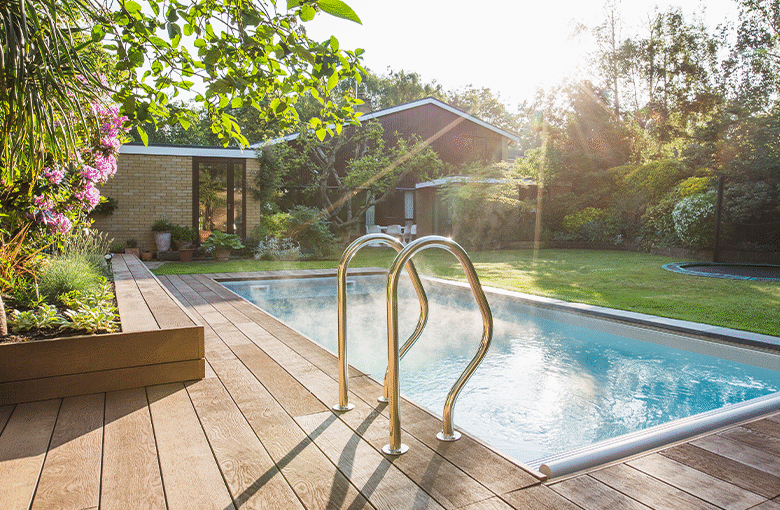
Imagine slipping into a sparkling, inviting pool only to face skin irritation or cloudy water- a common pitfall of imbalanced chemistry. Maintaining optimal pH, alkalinity, and chlorine isn’t just science; it’s the key to safe, enjoyable swimming and equipment longevity, backed by guidelines from the CDC and pool industry experts. Explore water chemistry fundamentals, ideal ranges for each parameter, testing tools, a step-by-step balancing guide, and pro troubleshooting tips to transform your pool care routine.
Understanding pH: The Foundation
The pH level represents the foundational element of pool water chemistry, quantifying the degree of acidity or alkalinity on a scale from 0 to 14. Research from the University of Florida IFAS Extension indicates that even a subtle shift of 0.2 pH units can diminish the effectiveness of sanitizers by 50%.
What pH Measures
The pH level quantifies the concentration of hydrogen ions in pool water, indicating whether the water is acidic (below 7.0, which may promote corrosion) or basic (above 7.8, potentially resulting in cloudy water and scaling).
Defined logarithmically as pH = -log[H], where [H] represents the hydrogen ion concentration, the pH scale ranges from 0 to 14. A pH of 1, comparable to battery acid, denotes high acidity, whereas a pH of 13, similar to bleach, indicates strong alkalinity.
For optimal swimmer comfort and equipment protection, maintain pool pH within the range of 7.2 to 7.8.
According to a Centers for Disease Control and Prevention (CDC) report on recreational water-associated illnesses, a pH reduction to 6.5 resulted in eye irritation among 30% of swimmers at the affected facilities.
To achieve accurate measurements, employ a digital pH meter, such as the LaMotte Colorimeter (priced at approximately $150). Submerge the probe, observe the digital readout, and adjust chemical treatments as necessary.
Environmental factors, including rainfall, can decrease pH by 0.1 to 0.3 units, while elevated bather loads may increase it due to contributions from sweat and sunscreens. Conduct testing on a weekly basis and immediately following periods of intensive use.
Ideal pH Range for Pools
The recommended pH range for swimming pools is 7.2 to 7.8, as established by the Centers for Disease Control and Prevention (CDC). This range optimizes chlorine efficacy, enhances swimmer comfort, and mitigates risks such as skin irritation or damage to pool equipment.
To sustain this balance, it is essential to regularly monitor and adjust the pH levels.
Should the pH fall below 7.2, incorporate soda ash at a rate of 1 pound per 10,000 gallons of water, which will increase the pH by approximately 0.2 units. Ahead of application, dissolve the soda ash thoroughly and distribute it evenly across the pool surface.
If the pH exceeds 7.8, apply muriatic acid diluted at a 1:10 ratio with water; 10 ounces per 10,000 gallons will reduce the pH by approximately 0.2 units.
For accurate dosing calculations tailored to the pool’s volume and existing chemical levels, utilize specialized applications such as PoolMath.
Research published in the Journal of Water Chemistry (2019) indicates that maintaining pH levels between 7.4 and 7.6 can decrease overall chemical requirements by 15%, thereby reducing operational costs and lessening environmental impacts.
Understanding Total Alkalinity
Total alkalinity serves as a critical buffer against pH fluctuations in pool water, thereby maintaining stability and preventing abrupt changes that could result in damage to pool liners or the formation of cloudy conditions.
Role in Water Stability
Total alkalinity plays a critical role in maintaining water stability by buffering against pH fluctuations.
Levels below 80 ppm can lead to pH instability, commonly known as “pH bounce,” while levels exceeding 120 ppm may result in scaling on pool surfaces.
To achieve proper balance, the Langelier Saturation Index (LSI) is employed, calculated using the formula LSI = pH + TF + CF + AF – 12.1.
The alkalinity factor (AF) directly incorporates the impact of total alkalinity on calcium carbonate saturation.
For example, the temperature factor (TF) accounts for water temperature, and the calcium hardness factor (CF) addresses calcium hardness levels.
Research from the Pool & Hot Tub Alliance indicates that a pool with 50 ppm alkalinity experienced a 0.5-unit pH drop following rainfall, heightening the risk of corrosion.
For practical management, it is advisable to conduct monthly testing with the Taylor K-2006 kit (approximately $50) to determine the LSI.
Maintain the index within the range of -0.3 to +0.3 to prevent scaling (LSI> 0.3) or corrosion (LSI <-0.3).
Adjustments to alkalinity should be made through the addition of sodium bicarbonate to promote long-term stability.
Recommended Alkalinity Levels
According to CDC guidelines, the recommended total alkalinity level for swimming pools is 80-120 parts per million (ppm). This range provides a stable foundation for pH management, preventing water cloudiness and ensuring the continued efficacy of sanitizers.
For vinyl-lined pools, maintain levels between 80-100 ppm to prevent surface damage; for concrete pools, target 100-120 ppm to enhance structural durability.
Perform testing on a weekly basis using a reliable kit, such as the Taylor K-2006.
To elevate alkalinity levels, incorporate baking soda (sodium bicarbonate) at a rate of 1.5 pounds per 10,000 gallons of water, which will increase the level by 10 ppm. Refrain from using stabilizers such as cyanuric acid in this context, as they primarily influence chlorine levels rather than alkalinity.
A study by the National Spa & Pool Institute demonstrated that maintaining alkalinity at 100 ppm can reduce chemical costs by 20% in residential pools.
Adjustments by volume for a +20 ppm increase (baking soda in pounds):
| Pool Volume (gallons) | Baking Soda (lbs) |
|---|---|
| 10,000 | 3 |
| 20,000 | 6 |
| 30,000 | 9 |
| 50,000 | 15 |
Ensure the baking soda is fully dissolved and the water is circulated for at least 24 hours prior to retesting.
Understanding Chlorine Sanitization
Chlorine serves as the primary sanitizer in swimming pools, effectively eliminating bacteria and algae. However, its efficacy is contingent upon maintaining proper chemical balance to prevent the formation of byproducts such as chloramines, which can produce unpleasant odors and cause irritation to the eyes and skin.
Types of Chlorine Products
Standard chlorine-based sanitizers for pool maintenance include calcium hypochlorite granules (65% available chlorine, priced at $40 per 25 pounds), liquid chlorine (10-12.5% concentration, $5 per gallon), and trichlor tablets (90% chlorine content, formulated for slow dissolution in automated feeders).| Product | Active Chlorine % | Price | Best For | Pros/Cons | |————————–|——————-|—————-|———————–|—————————————————————————| | Calcium Hypochlorite | 65% | $40/25 lbs | Shock treatment | Pros: High potency, rapid action; Cons: Elevates calcium hardness | | Sodium Hypochlorite (Liquid) | 10-12.5% | $5/gallon | General sanitation | Pros: Simple dosing, residue-free; Cons: Rapid degradation, increases pH | | Trichlor | 90% | $50/50 lbs | Floaters/feeders | Pros: Stabilized formulation, convenient tablet form; Cons: Lowers pH, adds cyanuric acid (CYA) | | Dichlor | 56-62% | $30/25 lbs | Outdoor pools | Pros: Incorporates CYA, highly soluble; Cons: Higher cost per unit of chlorine | | Lithium Hypochlorite | 35% | $60/25 lbs | Quick boosts | Pros: Leaves no residue, dissolves quickly; Cons: Elevated cost, reduced potency |
For outdoor pools, dichlor is particularly suitable owing to its integrated cyanuric acid (CYA) stabilization, which mitigates chlorine loss from ultraviolet exposure and proves advantageous in sun-intensive environments. Trichlor, by comparison, yields a greater chlorine output but demands precise pH oversight due to its acidic nature.
These sanitizers may be administered via economical floating dispensers (approximately $20) to promote uniform dispersal throughout the pool. It is critical to avoid combining them with acidic substances, as such interactions can generate hazardous gases.
To address algae proliferation through superchlorination, increase free chlorine levels to 10 parts per million using calcium hypochlorite granules, followed by thorough brushing of pool surfaces and continuous filtration for at least 24 hours.
Optimal Free Chlorine Levels
The Centers for Disease Control and Prevention (CDC) recommends maintaining optimal free chlorine levels of 1.0 to 3.0 parts per million (ppm) in residential pools.
This range effectively eliminates pathogens while minimizing the formation of excess combined chlorine, which can cause skin and eye irritation.
To achieve and sustain these levels, it is advisable to test pool water weekly using the DPD (N,N-diethyl-p-phenylenediamine) method.
Reliable and cost-effective testing kits, such as AquaChek strips (available for approximately $10 per 100 strips), provide accurate measurements of free chlorine concentrations.
Target free chlorine levels of 2 to 4 ppm, in conjunction with 30 to 50 ppm of cyanuric acid stabilizer, to protect against ultraviolet (UV) degradation and preserve chlorine efficacy.
Combined chlorine levels should be calculated by subtracting free chlorine readings from total chlorine measurements and maintained below 0.5 ppm to prevent irritation.
If free chlorine levels fall below the recommended range, increase them by 1 ppm using 2 ounces of trichlor tablets per 10,000 gallons of water.
In cases where combined chlorine exceeds 0.5 ppm, shocking the pool with a higher dose of chlorine is necessary to restore balance.
A 2015 study published in the American Journal of Public Health demonstrated that 2 ppm of free chlorine eliminates 99.9% of Escherichia coli (E. coli), emphasizing the critical importance of consistent monitoring for ensuring pool safety and public health.
Essential Testing Tools and Methods
Essential testing tools, such as the Taylor K-2006 comprehensive kit priced at $50, facilitate precise measurements of pH, alkalinity, and chlorine levels, thereby preventing issues that could result in annual repair costs exceeding $500.| Tool Name | Price | Key Features | Best For | Pros/Cons | |————————|——-|—————————————|—————————|————————————| | Taylor K-2006 | $50 | Drop-test for 7 parameters | Accurate home use | Pros: Reliable; Cons: Liquid reagents | | LaMotte Scuba II | $300 | Digital colorimeter for chlorine/pH | Professional pools | Pros: Fast results; Cons: Battery-dependent | | AquaChek Silver | $15 | Strip tests for 6 parameters | Beginners/quick checks | Pros: Easy, no tools; Cons: Less precise | | Hach Pocket Colorimeter II | $400 | Photometric for chlorine/alkalinity | Lab-grade accuracy | Pros: EPA-compliant; Cons: High cost | | PoolLab 2.0 | $250 | Photometer with app integration | Tech-savvy users | Pros: Bluetooth data; Cons: App glitches | | Tetratest Master | $25 | Color disc/colorimetric for basics | Budget home kits | Pros: Affordable; Cons: Subjective reading |
For novice users, Taylor kits offer greater precision than AquaChek strips, utilizing titration methods for alkalinity and colorimetric techniques for chlorine, although the preparation of strips requires only five minutes. Digital pH meters should be calibrated weekly to maintain accuracy, in accordance with EPA guidelines that recommend daily testing for public pools to ensure safe water quality levels (EPA 2018 Water Quality Standards).
Step-by-Step Balancing Process
Balancing pool water requires a systematic process of testing and adjusting pH, alkalinity, and chlorine levels in sequence, which typically requires 1-2 hours for the initial treatment and approximately 30 minutes for weekly maintenance.
To achieve optimal results, adhere to the following procedures and utilize a reliable Taylor test kit to ensure precise measurements.
- Test the water parameters: Measure and record the pH (ideal range: 7.2-7.8), total alkalinity (80-120 ppm), and free chlorine (1-3 ppm). This step generally takes 15 minutes.
- Adjust alkalinity first: If the level is below 80 ppm, incorporate baking soda (for example, 1.5 pounds will increase alkalinity by 10 ppm in 10,000 gallons). Allow 4-6 hours for circulation, then retest the water.
- Balance the pH: Elevate it using soda ash or reduce it with muriatic acid (20 ounces will lower pH by 0.2 in 10,000 gallons). Retest after 1 hour.
- Incorporate chlorine: Apply chlorine granules to achieve a rapid increase to 2 ppm.
- Verify calcium hardness (200-400 ppm) and stabilizer levels (30-50 ppm cyanuric acid).
- Conduct a retest after 24 hours. Employ a pool calculator application to determine appropriate dosing quantities. A common error is adding chemicals simultaneously, which can trigger adverse reactions; therefore, follow the Centers for Disease Control and Prevention (CDC) guidelines for sequential addition to mitigate potential issues.
Maintenance and Troubleshooting Tips
Regular maintenance, encompassing weekly testing and brushing, ensures that pools remain clear and safe for use, while targeted troubleshooting resolves common issues such as cloudy water resulting from elevated pH levels (> 7.8).
To address cloudy water caused by high alkalinity (> 120 ppm), introduce muriatic acid to reduce the levels, followed by filtration for a minimum of 24 hours. For green water attributable to insufficient chlorine (<1 ppm) and algal growth, apply shock treatment to achieve 10 ppm using calcium hypochlorite.
Prevent scaling due to excessive calcium (> 400 ppm) by employing sequestrants, such as Jack’s Magic. Mitigate corrosion arising from low pH (<7.2) by increasing the pH with soda ash.
A case study conducted by the Pool Research Center in Florida demonstrated that superchlorination reduced the recurrence of green water by 80%.
Adhere to the following best practices:
- Brush pool walls weekly,
- Backwash the filter monthly,
- Monitor total dissolved solids (TDS) to maintain levels below 1500 ppm,
- Incorporate preventive algaecide (approximately $15 per bottle),
- Maintain logs of test results using applications such as PoolTrackr.
Consult EPA guidelines to uphold safe health standards. For more information visit ORCA Pools Maintenance location in Claremont.